
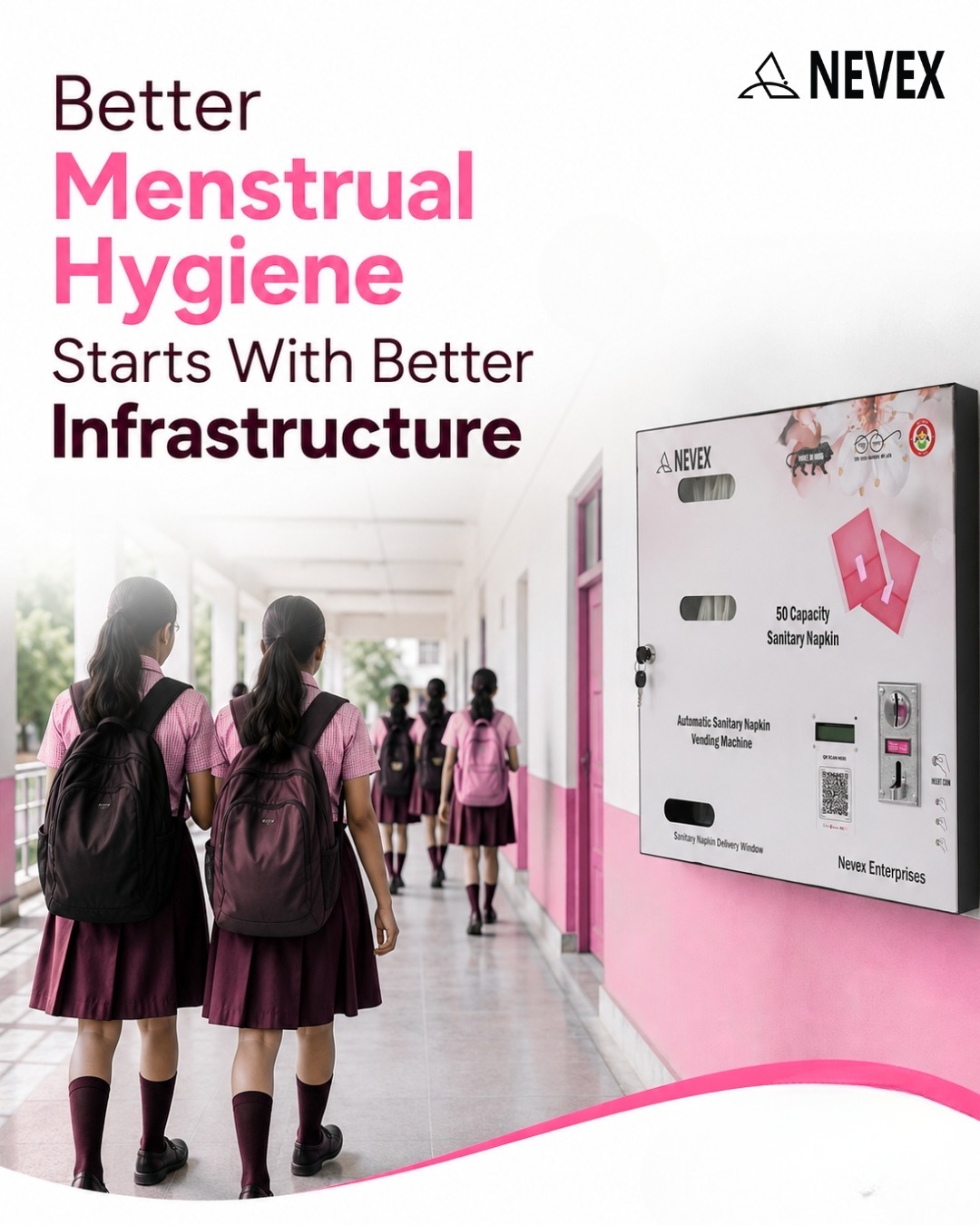
Why Every School Should Prioritize Menstrual Hygiene A girl misses school. Nobody asks why. Nobody follows up. And over a year, those missed days quietly turn into a gap in her education that nobody ever officially recorded. This happens far more often than most schools realise, and menstrual hygiene is usually the reason behind it. At Nevex, we manufacture sanitary pad vending machines and sanitary pad disposal machines for schools and colleges across India. So we've seen, firsthand, what changes when a school treats menstrual hygiene management as a priority instead of an afterthought. Here's why it deserves a place at the top of every school's hygiene and infrastructure plan, not somewhere at the bottom of it. The real cost of ignoring it 1. It directly affects attendance: Without access to a clean toilet, water, or a sanitary pad on campus, a girl on her period has two choices: stay uncomfortable for hours, or stay home. Multiply that across a school year, and menstrual hygiene becomes one of the biggest, least-discussed reasons for absenteeism among adolescent girls in India. 2. It affects confidence, not just attendance : A girl worried about a leak, or without a private space to change a pad, isn't focused on the lesson in front of her. She's focused on getting through the day unnoticed. That kind of anxiety, repeated month after month, chips away at her participation in class, in sports, and eventually in her own confidence to show up fully. 3. It normalises silence, generation after generation: If a school never talks about periods, and never provides for them, it teaches every student, girls and boys alike, that this is something to hide. That silence doesn't stay in the school gates. It travels home, into workplaces, and into the next generation of parents. 4. It's often the only place some girls will ever get this support.: For many students, especially in smaller towns, school may be the only place with any menstrual hygiene facility at all. If the school doesn't provide it, there may be no backup plan for that student that day. What 'prioritizing' menstrual hygiene actually looks like It's not just a poster in the corridor or a one-time awareness session. Real menstrual hygiene management in schools means: A sanitary pad vending machine is installed in the girls' washroom, so a pad is available the moment it's needed, without a student having to ask a teacher or leave the building. A sanitary pad disposal machine in the same washroom, so used pads are destroyed hygienically instead of piling up in open bins or blocking drains. Clean, private toilets with water and a functioning lock, which sounds basic, but is still missing in a large number of Indian schools. Ongoing menstrual health education, not a single session, covering both girls and boys, so understanding replaces stigma. A no-questions-asked policy, where a student can access a pad or step out of class without having to explain herself. Put together, this is what menstrual hygiene management in schools should look like on the ground, not a policy document, but working infrastructure a student can actually use without hesitation. Where Nevex fits into this This is exactly the gap we work to close. Nevex builds automatic sanitary pad vending machines for schools, available in 25, 40, and 50 pad capacities, designed to run on a simple push-button mechanism with no coins and no UPI required. That matters a lot for schools and CSR-funded hygiene programmes that want to offer free sanitary napkins without adding any payment friction for students. Alongside that, we manufacture sanitary pad disposal machines, so a school can offer both access and disposal in the same washroom, a complete women's hygiene setup rather than half a solution. We've supplied these machines to schools, colleges, and universities across India as part of women hygiene and CSR initiatives, and we know exactly how to help a school plan the right setup, whether that's for a single washroom or a full campus rollout. If your school, college, or trust is serious about menstrual hygiene awareness and wants working infrastructure instead of a one-time drive, get in touch with Nevex. We'll help you figure out the right sanitary napkin vending machine and disposal setup for your campus. Quick answers to what people usually ask Why should schools prioritize menstrual hygiene? Because it directly affects whether girls attend school, participate in class, and stay confident during their periods. Without proper facilities, menstrual hygiene becomes a hidden reason for absenteeism and dropout. How does poor menstrual hygiene affect a girl's education? Without access to clean toilets, water, or sanitary pads, girls often miss school during their periods. Over months and years, this adds up to a real loss in classroom time and confidence. What menstrual hygiene facilities should every school have? At minimum, a school should have a private toilet with water and a lock, a sanitary pad vending machine for on-demand access, and a sanitary pad disposal machine to manage waste hygienically. Why is a sanitary pad vending machine useful in schools? It gives students access to a pad instantly, without having to ask a teacher or leave the school, which removes a major barrier that keeps girls away from class during their periods. Should menstrual hygiene education include boys? Yes. Educating boys alongside girls helps remove the stigma around periods and builds a generation of men who understand and support the women around them. Can schools get menstrual hygiene machines through CSR funding? Yes, many schools install sanitary pad vending and disposal machines through CSR-backed women hygiene programmes, which is exactly the kind of setup Nevex regularly supplies for schools and colleges.


This is your website preview.
Currently it only shows your basic business info. Start adding relevant business details such as description, images and products or services to gain your customers attention by using Boost 360 android app / iOS App / web portal.
Why Every School Should Prioritize Menstrual Hygiene
2026-07-30T05:00:06
Why Every School Should Prioritize Menstrual Hygiene A girl misses school. Nobody asks why. Nobody follows up. And over a year, those missed days quietly turn into a gap in her education that nobody ever officially recorded. This happens far more often than most schools realise, and menstrual hygiene is usually the reason behind it. At Nevex, we manufacture sanitary pad vending machines and sanitary pad disposal machines for schools and colleges across India. So we've seen, firsthand, what changes when a school treats menstrual hygiene management as a priority instead of an afterthought. Here's why it deserves a place at the top of every school's hygiene and infrastructure plan, not somewhere at the bottom of it. The real cost of ignoring it 1. It directly affects attendance: Without access to a clean toilet, water, or a sanitary pad on campus, a girl on her period has two choices: stay uncomfortable for hours, or stay home. Multiply that across a school year, and menstrual hygiene becomes one of the biggest, least-discussed reasons for absenteeism among adolescent girls in India. 2. It affects confidence, not just attendance : A girl worried about a leak, or without a private space to change a pad, isn't focused on the lesson in front of her. She's focused on getting through the day unnoticed. That kind of anxiety, repeated month after month, chips away at her participation in class, in sports, and eventually in her own confidence to show up fully. 3. It normalises silence, generation after generation: If a school never talks about periods, and never provides for them, it teaches every student, girls and boys alike, that this is something to hide. That silence doesn't stay in the school gates. It travels home, into workplaces, and into the next generation of parents. 4. It's often the only place some girls will ever get this support.: For many students, especially in smaller towns, school may be the only place with any menstrual hygiene facility at all. If the school doesn't provide it, there may be no backup plan for that student that day. What 'prioritizing' menstrual hygiene actually looks like It's not just a poster in the corridor or a one-time awareness session. Real menstrual hygiene management in schools means: A sanitary pad vending machine is installed in the girls' washroom, so a pad is available the moment it's needed, without a student having to ask a teacher or leave the building. A sanitary pad disposal machine in the same washroom, so used pads are destroyed hygienically instead of piling up in open bins or blocking drains. Clean, private toilets with water and a functioning lock, which sounds basic, but is still missing in a large number of Indian schools. Ongoing menstrual health education, not a single session, covering both girls and boys, so understanding replaces stigma. A no-questions-asked policy, where a student can access a pad or step out of class without having to explain herself. Put together, this is what menstrual hygiene management in schools should look like on the ground, not a policy document, but working infrastructure a student can actually use without hesitation. Where Nevex fits into this This is exactly the gap we work to close. Nevex builds automatic sanitary pad vending machines for schools, available in 25, 40, and 50 pad capacities, designed to run on a simple push-button mechanism with no coins and no UPI required. That matters a lot for schools and CSR-funded hygiene programmes that want to offer free sanitary napkins without adding any payment friction for students. Alongside that, we manufacture sanitary pad disposal machines, so a school can offer both access and disposal in the same washroom, a complete women's hygiene setup rather than half a solution. We've supplied these machines to schools, colleges, and universities across India as part of women hygiene and CSR initiatives, and we know exactly how to help a school plan the right setup, whether that's for a single washroom or a full campus rollout. If your school, college, or trust is serious about menstrual hygiene awareness and wants working infrastructure instead of a one-time drive, get in touch with Nevex. We'll help you figure out the right sanitary napkin vending machine and disposal setup for your campus. Quick answers to what people usually ask Why should schools prioritize menstrual hygiene? Because it directly affects whether girls attend school, participate in class, and stay confident during their periods. Without proper facilities, menstrual hygiene becomes a hidden reason for absenteeism and dropout. How does poor menstrual hygiene affect a girl's education? Without access to clean toilets, water, or sanitary pads, girls often miss school during their periods. Over months and years, this adds up to a real loss in classroom time and confidence. What menstrual hygiene facilities should every school have? At minimum, a school should have a private toilet with water and a lock, a sanitary pad vending machine for on-demand access, and a sanitary pad disposal machine to manage waste hygienically. Why is a sanitary pad vending machine useful in schools? It gives students access to a pad instantly, without having to ask a teacher or leave the school, which removes a major barrier that keeps girls away from class during their periods. Should menstrual hygiene education include boys? Yes. Educating boys alongside girls helps remove the stigma around periods and builds a generation of men who understand and support the women around them. Can schools get menstrual hygiene machines through CSR funding? Yes, many schools install sanitary pad vending and disposal machines through CSR-backed women hygiene programmes, which is exactly the kind of setup Nevex regularly supplies for schools and colleges.
2026-07-30T05:00:06


Submit Your Enquiry