What Happens to a Sanitary Pad After You Throw It Away?
You wrap it in newspaper or a plastic bag, drop it in the bin, and forget about it. That's the last you ever think about it. But that pad doesn't just disappear. It goes somewhere, and what happens to it next is a lot messier than most of us realise.
At Nevex, we build sanitary pad disposal machines for schools, colleges, and workplaces, so we've had to look closely at this part of the story, the part that gets skipped in almost every conversation about periods. Here's what actually happens after that pad leaves your hand.
First stop: the household dustbin
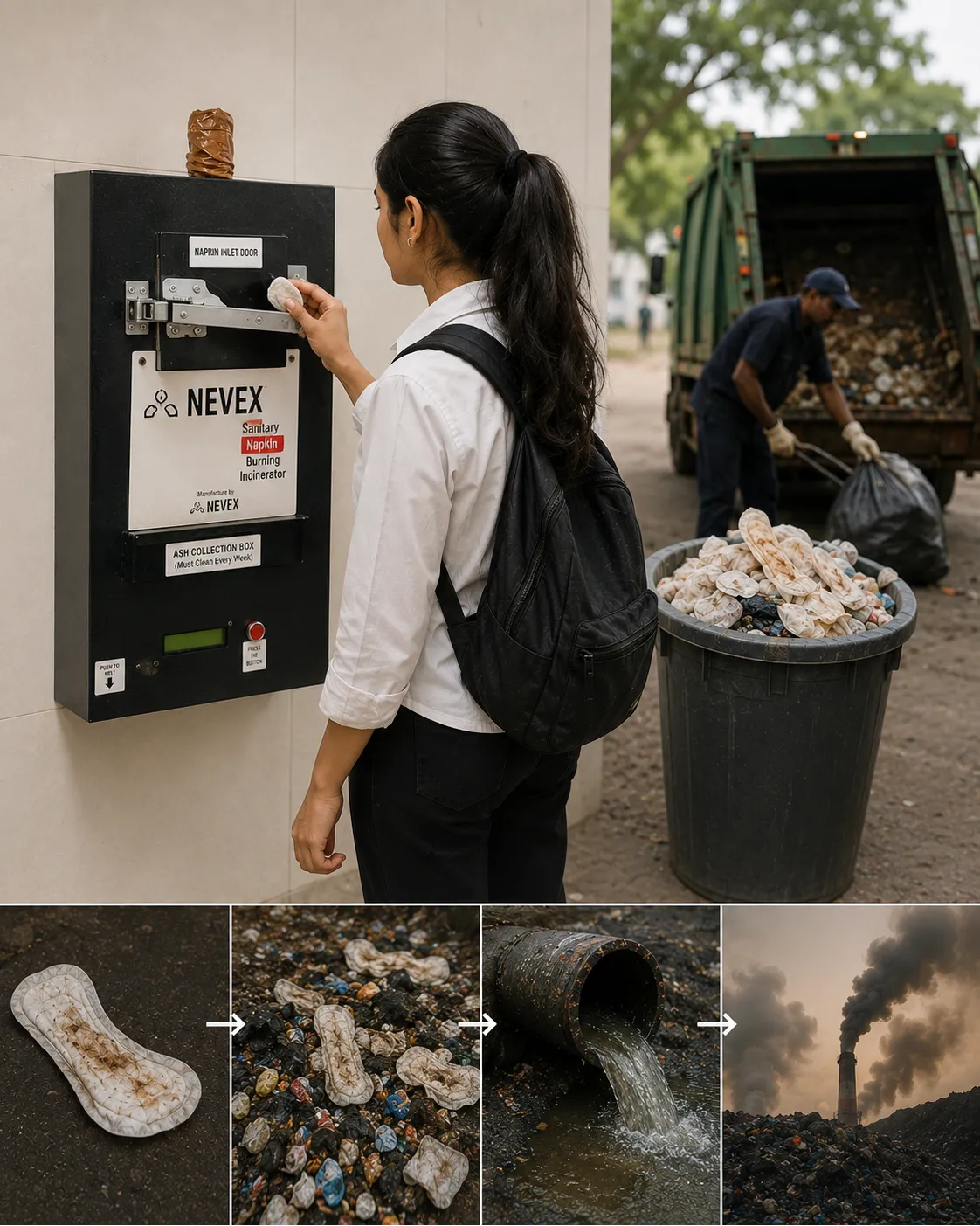
In most Indian homes, a used pad goes straight into the regular household dustbin, wrapped in paper or a plastic bag, mixed in with kitchen waste, packaging, and everything else. There's rarely a separate bin for it, and almost nobody segregates it as a distinct category of waste. From here, it travels with the rest of the household garbage to wherever that garbage goes next, a local dump, a landfill, or in some cases, straight into a drain or open ground.
The person who actually handles it
Before it reaches any landfill, someone has to physically pick it up. That's usually a waste worker and often, it's someone with no protective gear, no gloves, no separation between 'safe' and 'biological' waste. Studies have found that a large share of waste pickers in India develop skin infections simply from handling this kind of waste bare-handed, day after day. It's an uncomfortable fact, but a real one, the person paying the biggest health cost in this entire chain is usually the one with the least choice in the matter.
Where it actually ends up
India generates a staggering volume of this waste. Estimates put the number at roughly 12.3 billion disposable sanitary pads used every year, adding up to well over 100,000 tonnes of menstrual waste reaching landfills annually. And these aren't harmless. A typical disposable pad is close to 90% plastic, roughly the same amount of plastic as four plastic bags packed into a single pad.
Once it's in a landfill, it just sits there. Decomposition estimates for a single pad range from 500 to 800 years. That means a pad thrown away today will likely still be sitting in the ground, mostly intact, long after everyone reading this is gone.
What if it's flushed instead?
Some people flush pads down the toilet instead of binning them, assuming it's a cleaner option. It isn't. The super-absorbent material inside a pad is designed to swell up when it touches water, which is exactly what makes it so effective during your period, and exactly what makes it a disaster in a pipe. It swells inside the plumbing, blocks the flow, and can back up an entire sewage line, causing overflow problems well beyond your own bathroom.
What about incineration?
Small incinerators have become common in schools and hostels as a way to deal with this waste on-site, and in principle, that's a reasonable idea, burning waste locally instead of sending it to a landfill. But a lot of these units are low-cost, poorly built, and completely unmonitored. Burnt at the wrong temperature, they release toxic fumes into the same air the people around them are breathing, and there's often no testing or oversight to check what's actually coming out of the chimney.
So even the disposal method that sounds like a fix can quietly become its own problem, if it isn't done properly.
Why this matters more than it seems
None of this is really about one pad. It's about what happens when 12 billion of them move through a system that was never really built to handle them, no segregation at the household level, waste workers without protection, landfills that don't break this material down, and disposal machines that often don't meet any safety standard. The result is an environmental and public health problem that's been quietly growing for years, mostly out of sight, because nobody wants to talk about what happens after the bin.
What actually needs to change
Real change here doesn't come from switching to a different colour of wrapper. It comes from fixing where the pad goes after use:
- Proper, monitored incineration, built to a real safety standard, not an improvised bin with a flame under it
- On-site disposal in schools and workplaces, so pads don't end up mixed into general household waste at all
- Protection for waste workers, so the people handling this waste aren't paying for it with their own health
- Awareness that includes disposal, not just access to pads, since half the problem starts right after the pad is used
Where Nevex fits into this
This is the exact gap we work on. Nevex manufactures sanitary pad disposal machines built for schools, colleges, hospitals, and workplaces, designed to destroy used pads safely and hygienically on-site, instead of letting them travel through a household bin, a waste picker's hands, and a landfill that won't break them down for centuries.
If your institution wants a real answer to 'what happens after the pad is thrown away,' instead of leaving that question unanswered, get in touch with Nevex. We'll help you set up proper, safe disposal for your washrooms.
Frequently asked questions
How long does it take for a sanitary pad to decompose?
Estimates range from 500 to 800 years for a single disposable pad to break down, since most commercial pads are around 90% plastic.
Is it safe to flush a sanitary pad down the toilet?
No. The absorbent material inside a pad swells up when wet, which can block pipes and cause sewage backups. Pads should always be disposed of in a bin or a proper disposal unit, never flushed.
How much sanitary waste does India generate every year?
Estimates suggest around 12.3 billion disposable sanitary pads are used annually in India, adding up to over 100,000 tonnes of menstrual waste reaching landfills each year.
Are small incinerators a safe way to dispose of sanitary pads?
Not always. Many low-cost incinerators used in schools and hostels aren't properly monitored, and burning waste at the wrong temperature can release toxic fumes into the air.
Who is most affected by improper sanitary pad disposal?
Waste workers who handle household garbage, often without protective gear, are among the most affected, along with communities near landfills where this waste accumulates untreated for decades.
What's the safest way for schools and offices to dispose of used pads?
Through a dedicated sanitary pad disposal machine on-site, which destroys the waste hygienically and safely, rather than letting it mix into general household or municipal waste.
Keywords