How to Check a Sanitary Waste Incinerator Before You Buy It
Most incinerator listings tell you the voltage and the colour. They rarely tell you the one thing a school principal or facility head gets asked later: does this machine burn sanitary waste properly, and can you prove it?
There is a reason to ask. A Citizen Matters investigation reported that Pune's 12 municipal small-scale incinerators ran at about 350 to 450°C, well below the 850 to 1100°C range the WHO recommends for complete combustion. Cheap units that smoke and smell are why small incinerators have a bad name. Here are six questions that separate a proper unit from a drum with a heater.
1. How many chambers does it have?
A single chamber burns waste and releases whatever comes off it. A twin-chamber design passes the gases into a second chamber to burn them again at a higher temperature. An NGT interim order, as reported, requires twin-chamber units operating at 800°C or higher. If a seller cannot say how many chambers the unit has, stop there.
2. What temperature does it actually reach, and how do you know?
Ask for the operating temperature of each chamber and whether the unit has a temperature display or controller. Emissions are highest at start-up and shutdown, when the unit is still cold, so also ask how long it takes to reach working temperature. A small unit that is switched on and off several times a day spends a lot of its life in that bad zone.
For reference, the CPCB standard for biomedical waste incinerators asks for a primary chamber of at least 800°C and a secondary chamber of 1050°C, plus or minus 50, with gases held for at least two seconds. That standard is written for biomedical waste incinerators. Ask any seller which standard their unit is built to, and get the answer in writing.
3. Is there a lab test certificate?
CPCB guidelines for small community incinerators say modular units must meet the general emission standards under the Environment (Protection) Act, 1986, and carry a test certificate from a recognised or accredited laboratory. Ask to see it. Check the model number matches the machine you are buying and read the date.
4. What is the stack and what filters the smoke?
Ask for the stack height. CPCB guidelines for small units, as reported, ask for the flue gas stack to be at least 2 metres above the roof or the nearest building, unless the state pollution control board says otherwise. Then ask what treats the smoke before it leaves. A carbon filter helps with odour and some pollutants. Ask the seller to say plainly what it removes and how often the carbon is replaced.
5. What happens to the ash?
Every incinerator leaves ash. A study cited in the same Citizen Matters piece found no provision for ash disposal in the units it reviewed. Ask how much ash comes out per batch, how it is removed, and who is responsible for disposing of it. A buyer who skips this question ends up with a bag of ash and no plan.
6. Which waste is it meant for?
This is the question that gets schools and offices into trouble. Under the Solid Waste Management Rules, 2016, as reported, small incinerators are meant for cloth or cotton based sanitary waste, and infectious hospital waste belongs in a licensed biomedical waste facility. A machine sold for napkins, masks and PPE is not a machine for hospital infectious waste. Ask the seller to list what the unit can and cannot burn, and keep it with your records.
What we do with these questions
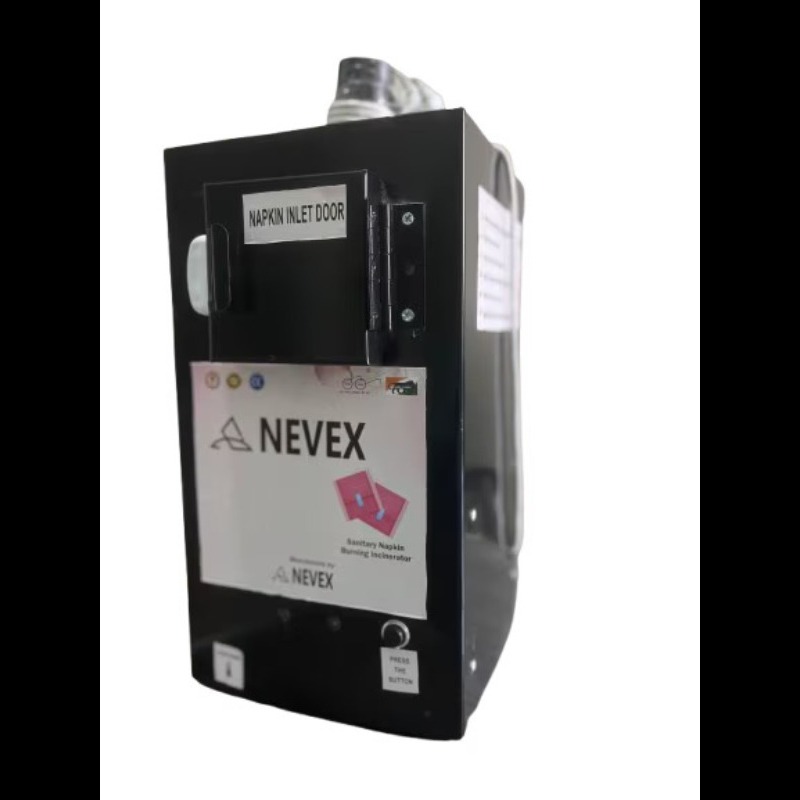
Our biomedical waste incinerator with carbon filter is made in Pune for sanitary napkins, PPE kits and masks. It runs on 230V AC and 50Hz, has a powder-coated mild steel body, is floor standing and carries a one year warranty against manufacturing defects.
For everything else on this list, put the six questions to us and we will answer in writing for the exact model you are considering. Use the same six with any other seller. Compare the answers side by side. If one seller will not give written answers, that tells you something.
Write to info@nevex.in or call 9146694504. Tell us how many women use the washroom block and how many napkins you expect to dispose of a day, and we will suggest a unit and a disposal plan.
Temperature, chamber and stack figures are from CPCB's incineration standards and from Citizen Matters reporting on small-scale sanitary waste incinerators. Check current rules with your State Pollution Control Board before purchase.
Keywords