
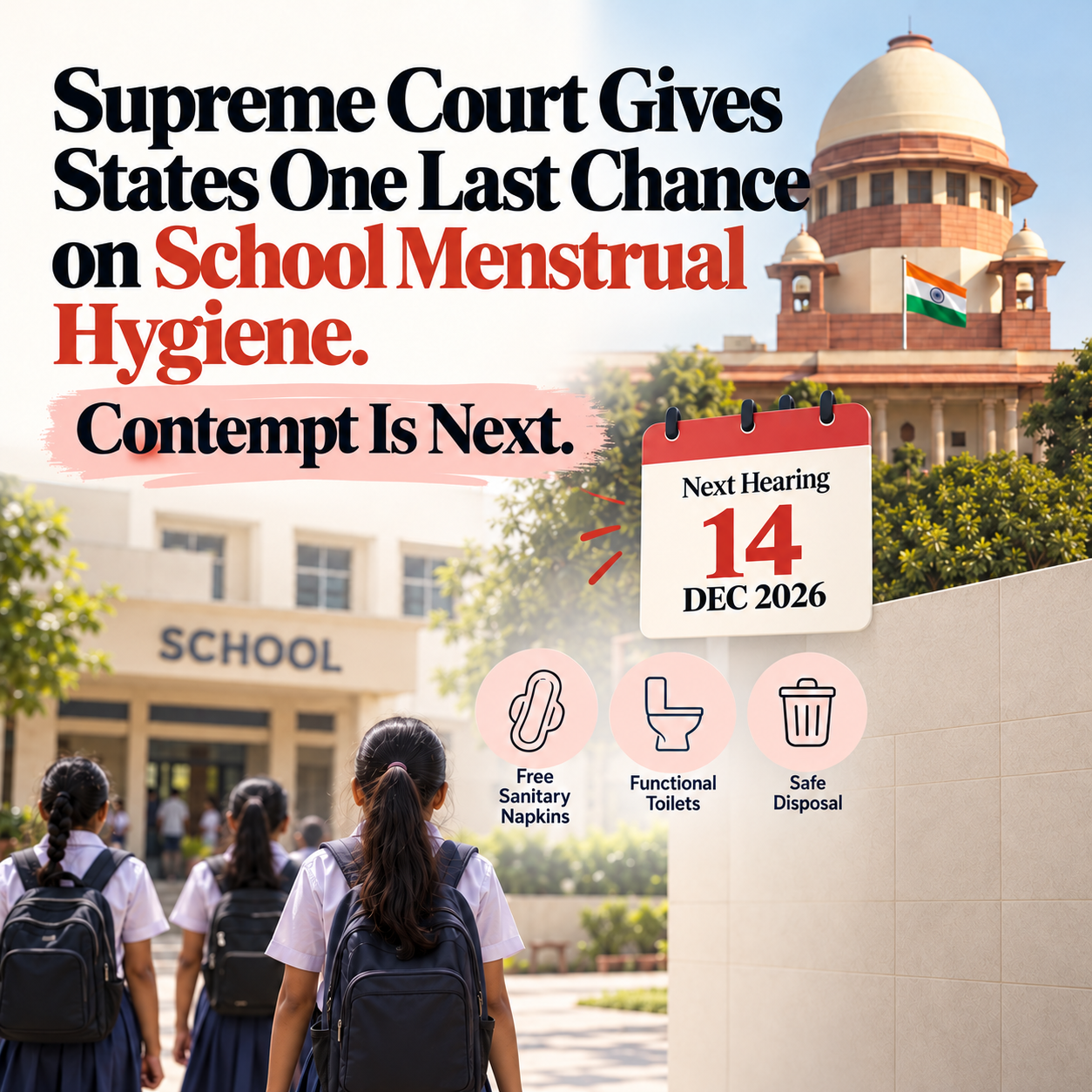
On 13 October 2026, the Supreme Court granted States and Union Territories 'one last opportunity' to report what they have done about menstrual hygiene in schools. If they do not respond by the next hearing on 14 December 2026, the Court said it will issue contempt notices to the Chief Secretaries concerned. The trigger was straightforward. The Union government had written to every State and UT asking for compliance details. Not one replied. Appearing for the Union, ASG Aishwarya Bhati told the bench of Justices J.B. Pardiwala and R. Mahadevan as much, and the Court asked how the right would be realised if the judgment 'remains on paper'. In Dr Jaya Thakur v. Union of India, decided on 30 January 2026, the Court held menstrual health and hygiene to be part of the right to life under Article 21 and directed every school, government and private, urban and rural, to provide free sanitary napkins, functional gender-segregated toilets and safe disposal. It kept the case open to monitor compliance. The Court reviewed progress on 1 September 2026. Union data put 39, 439 girls' toilets as still needing to be made functional, of which 30, 458 had been built and 4, 236 were under construction, leaving a gap of 4, 745. The September review is where this gets specific, because the Court checked the arithmetic. Karnataka, Jammu and Kashmir, Odisha and Arunachal Pradesh all reported full sanitary napkin vending machine coverage, and the Court noted their numbers came in below their own total school counts. Disposal data from Bihar, Gujarat, Delhi, Jharkhand, Rajasthan and Uttar Pradesh showed discrepancies. Tamil Nadu and Assam claimed saturation that did not match their school numbers. Punjab's report was illegible. The Court said some responses showed 'non-application of mind' and were filed as a formality. It then changed what reporting looks like. States must now report gaps rather than achievements: schools without functional segregated toilets, without water connectivity, without accessibility and privacy, without menstrual absorbents, without disposal. For each gap, the cause and the time needed to close it. It also directed District Education Officers to form teams of teachers and carry out surprise inspections of every school in their district, with findings and student feedback placed on record. So a school that reported a machine on paper is now exposed to someone walking in to look at it. This one matters if you are buying pads. The January judgment required oxo-biodegradable napkins manufactured to the ASTM D-6954 standard. In the September order, the Court read that requirement as biodegradable, biocompatible and compostable napkins conforming to ISO 17088 read with IS 5405. If your tender or purchase order still quotes ASTM D-6954, update it. The Court also said States should move gradually towards sustainable options including reusable napkins, cloth pads, menstrual cups and period underwear, starting with educating girls about reusable napkins. If you run a school or a district, these are the things an inspection team or a compliance report will ask about. Functional toilets: Whether every girls' toilet is functional on the Court's definition, which includes water, privacy, accessibility and a door that closes. Access to sanitary napkins: Whether pads are actually available, free, and reachable inside the toilet rather than locked in an office. The judgment prefers vending machines inside toilet premises, with a designated school authority holding stock as the fallback where a machine is not yet installed. Safe disposal: Whether disposal exists and works. A covered bin in each toilet unit, cleaned and maintained, and a disposal machine or incinerator where volume calls for it. Napkin standards: Whether your napkins meet ISO 17088 with IS 5405. Compliance evidence: Whether you can show it. Installation records, refill logs and maintenance records are what turn a claim into evidence, and the September order is a clear signal that unevidenced claims get checked. 14 December 2026, the next hearing date. States and UTs that have not responded to the Union by then face contempt notices to their Chief Secretaries. Yes. The January 2026 judgment covers government and private schools alike. Biodegradable, biocompatible and compostable napkins conforming to ISO 17088 read with IS 5405, per the September 2026 order. This replaces the earlier ASTM D-6954 reference. District Education Officers have been directed to form teams of teachers for surprise inspections of all schools in their district, and to place findings and student feedback on record. Nevex manufactures sanitary napkin vending machines, disposal machines and incinerators in Pune, with installations running in Kendriya Vidyalayas, universities and schools since 2018. If you are a school or a district office working towards the December hearing, send us the number of schools and the washrooms per school. We will come back with a capacity plan and specification text covering both vending and disposal, written to match what the order asks for. Write to info@nevex.in or call 08048126655.Supreme Court Gives States One Last Chance on School Menstrual Hygiene. Contempt Is Next
How We Got Here
The Part Schools Should Pay Attention To
The Napkin Specification Has Changed
What to Have Ready Before 14 December
Frequently Asked Questions
What Is the Deadline?
Does This Apply to Private Schools?
Which Napkin Standard Applies Now?
Who Will Check?
If You Need the Facilities in Place
SAHYADRIENTERPRISE Products
919146694504
Chat with us 


This is your website preview.
Currently it only shows your basic business info. Start adding relevant business details such as description, images and products or services to gain your customers attention by using Boost 360 android app / iOS App / web portal.
2026-10-28T17:41:55
On 13 October 2026, the Supreme Court granted States and Union Territories 'one last opportunity' to report what they have done about menstrual hygiene in schools. If they do not respond by the next hearing on 14 December 2026, the Court said it will issue contempt notices to the Chief Secretaries concerned. The trigger was straightforward. The Union government had written to every State and UT asking for compliance details. Not one replied. Appearing for the Union, ASG Aishwarya Bhati told the bench of Justices J.B. Pardiwala and R. Mahadevan as much, and the Court asked how the right would be realised if the judgment 'remains on paper'. In Dr Jaya Thakur v. Union of India, decided on 30 January 2026, the Court held menstrual health and hygiene to be part of the right to life under Article 21 and directed every school, government and private, urban and rural, to provide free sanitary napkins, functional gender-segregated toilets and safe disposal. It kept the case open to monitor compliance. The Court reviewed progress on 1 September 2026. Union data put 39, 439 girls' toilets as still needing to be made functional, of which 30, 458 had been built and 4, 236 were under construction, leaving a gap of 4, 745. The September review is where this gets specific, because the Court checked the arithmetic. Karnataka, Jammu and Kashmir, Odisha and Arunachal Pradesh all reported full sanitary napkin vending machine coverage, and the Court noted their numbers came in below their own total school counts. Disposal data from Bihar, Gujarat, Delhi, Jharkhand, Rajasthan and Uttar Pradesh showed discrepancies. Tamil Nadu and Assam claimed saturation that did not match their school numbers. Punjab's report was illegible. The Court said some responses showed 'non-application of mind' and were filed as a formality. It then changed what reporting looks like. States must now report gaps rather than achievements: schools without functional segregated toilets, without water connectivity, without accessibility and privacy, without menstrual absorbents, without disposal. For each gap, the cause and the time needed to close it. It also directed District Education Officers to form teams of teachers and carry out surprise inspections of every school in their district, with findings and student feedback placed on record. So a school that reported a machine on paper is now exposed to someone walking in to look at it. This one matters if you are buying pads. The January judgment required oxo-biodegradable napkins manufactured to the ASTM D-6954 standard. In the September order, the Court read that requirement as biodegradable, biocompatible and compostable napkins conforming to ISO 17088 read with IS 5405. If your tender or purchase order still quotes ASTM D-6954, update it. The Court also said States should move gradually towards sustainable options including reusable napkins, cloth pads, menstrual cups and period underwear, starting with educating girls about reusable napkins. If you run a school or a district, these are the things an inspection team or a compliance report will ask about. Functional toilets: Whether every girls' toilet is functional on the Court's definition, which includes water, privacy, accessibility and a door that closes. Access to sanitary napkins: Whether pads are actually available, free, and reachable inside the toilet rather than locked in an office. The judgment prefers vending machines inside toilet premises, with a designated school authority holding stock as the fallback where a machine is not yet installed. Safe disposal: Whether disposal exists and works. A covered bin in each toilet unit, cleaned and maintained, and a disposal machine or incinerator where volume calls for it. Napkin standards: Whether your napkins meet ISO 17088 with IS 5405. Compliance evidence: Whether you can show it. Installation records, refill logs and maintenance records are what turn a claim into evidence, and the September order is a clear signal that unevidenced claims get checked. 14 December 2026, the next hearing date. States and UTs that have not responded to the Union by then face contempt notices to their Chief Secretaries. Yes. The January 2026 judgment covers government and private schools alike. Biodegradable, biocompatible and compostable napkins conforming to ISO 17088 read with IS 5405, per the September 2026 order. This replaces the earlier ASTM D-6954 reference. District Education Officers have been directed to form teams of teachers for surprise inspections of all schools in their district, and to place findings and student feedback on record. Nevex manufactures sanitary napkin vending machines, disposal machines and incinerators in Pune, with installations running in Kendriya Vidyalayas, universities and schools since 2018. If you are a school or a district office working towards the December hearing, send us the number of schools and the washrooms per school. We will come back with a capacity plan and specification text covering both vending and disposal, written to match what the order asks for. Write to info@nevex.in or call 08048126655.Supreme Court Gives States One Last Chance on School Menstrual Hygiene. Contempt Is Next
How We Got Here
The Part Schools Should Pay Attention To
The Napkin Specification Has Changed
What to Have Ready Before 14 December
Frequently Asked Questions
What Is the Deadline?
Does This Apply to Private Schools?
Which Napkin Standard Applies Now?
Who Will Check?
If You Need the Facilities in Place
2026-10-28T17:41:55


Submit Your Enquiry